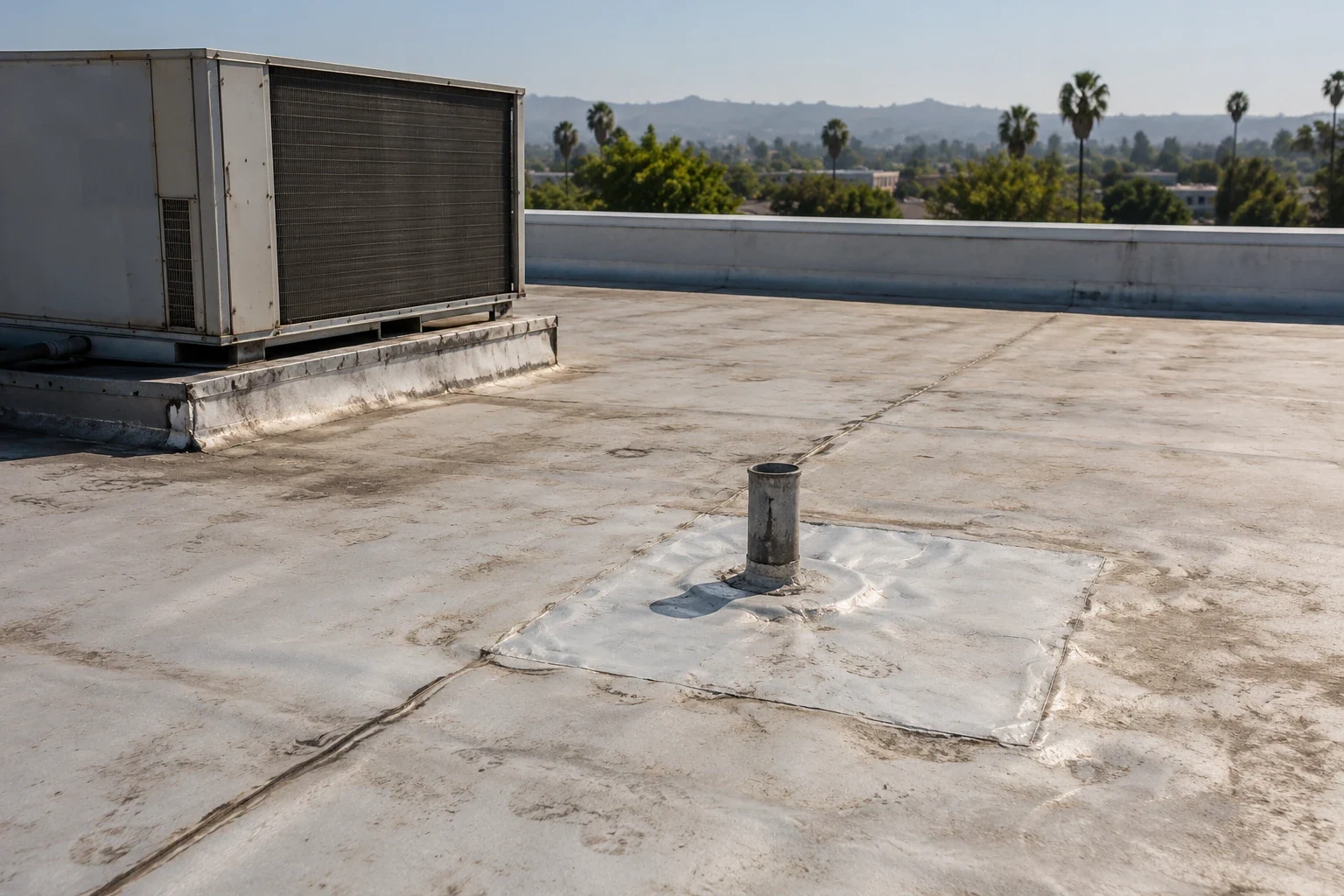

A small membrane opening can carry a larger repair allowance when the supporting layers and usable patch boundary have not been examined. We repair commercial roof punctures in Fairfield, CA, by establishing the damaged covering, adjacent material and concealed condition that affect the permanent correction. The general contractor needs those findings before counting each visible hole as an identical repair unit. Preparation, access and any required removal can differ even where openings appear similar in a photograph.
For a puncture repair anywhere in Fairfield, the building contact identifies the spaces below the defect and the access arrangements serving it. We explain the overhead examination and closure needed for the assigned property. That connects the repair scope to actual operating instructions before a work period is reserved.
The observed opening needs a location record
A cut near an equipment route may be associated with contact, but its location does not establish which event caused it. We examine the exposed damage and surrounding details, preserving photographs before temporary material changes its appearance. The record should identify what is observed and which cause remains unconfirmed. The general contractor can use that distinction when coordinating the repair with other trades without turning an inferred mechanism into an agreed damage account.
A separated seam beside the opening may need a different correction from the puncture itself. We examine both where their conditions affect the repair boundary. Identifying them separately helps the bid carry compatible preparation and connection tasks. A counted surface opening should not conceal an adjoining defect that must also be addressed for the proposed local correction.
The patch boundary reaches usable membrane
Patch dimensions depend on the material available for a suitable connection, not just the size of the visible breach. We identify the roof system and assess contamination, surface condition and adjoining attachment before choosing the preparation. Some damaged material may need removal to reach a dependable receiving area. The scope should state that boundary and the examination still needed where temporary material or a covered traffic route limits access.
A repair to the identified PVC assembly needs the joining method and preparation appropriate to that material. Other coverings have different requirements. We discuss the actual connection before procurement so the general contractor can obtain the required detail materials and retain any review dependency. A generic patch product does not resolve the compatibility question for an unidentified roof surface.
The opening can expose a separate quantity
Water passing through a puncture may affect insulation or support outside the membrane hole. We assess indicators of entry and the available assembly information, then identify further examination where the result changes retention. An authorized opening requires a compatible closure and coordination with the space below. The bid should separate that investigation from the confirmed membrane correction, making its purpose and approval clear.
Screening to select moisture investigation locations can help under suitable conditions, with confirmation appropriate to the roof and proposed decision. We retain the method's limits with the findings. The general contractor can establish a removal quantity from the resulting evidence or define the remaining allowance explicitly. A small surface opening should not become proof that concealed material is either sound or extensively damaged.
Temporary material affects later preparation
An active leak can require a holding measure while the permanent boundary is still being established. We discuss feasible protection based on the discovered condition and authorized access, with emergency calls available during nights, weekends and holidays. The initial work should preserve the damaged location and identify any further examination required. That gives the general contractor a clear immediate task while the operator coordinates protection of the interior exposure.
The lasting correction to the identified entry point may require temporary material removed for suitable preparation. We assess how that material interacts with the retained covering before defining the permanent connection. The pricing discussion should include the removal and closure tasks that follow. Reduced dripping after temporary work does not determine the concealed condition or settle the complete repair quantity.
Service access affects the finished detail
A patch near a service panel needs adequate clearance for its installation and later observation. We examine equipment edges, panel movement and the route technicians use where they affect the proposed connection. An equipment adjustment or outside-trade task may be needed before roofing preparation can be completed. The general contractor should retain that interface in the sequence, rather than order repair material while the detail remains inaccessible.
Correction at an adjoining curb flashing needs its own identified receiving surfaces and termination. We distinguish it from compatible traffic protection that may be considered along a service route. Traffic protection should not obstruct drainage or hide a connection that needs later checking. The proposed arrangement can then support the equipment task while leaving the roofing detail maintainable.
The release period serves the actual repair
Solano Town Center is a shopping district east of I-80 in Fairfield. For a proposed retail roofing visit nearby, the assigned operator needs the affected room and material route identified before work begins. We explain the access equipment and exposure associated with the repair boundary. A larger concealed-material correction can require different protection from a surface patch, and those differences should appear in the bid.
For commercial tasks across the Fairfield service area or near the Solano Town Center area, each building's instructions remain separate. We coordinate the actual released period with preparation and suitable application conditions. Closeout should retain the completed location, repair materials and any deferred adjacent concern, giving the contractor a defined permanent endpoint and the owner a useful record for later work.
A puncture assessment should record the membrane type, approximate dimensions, nearby seams, foot traffic and any equipment work that could have contacted the roof. Do not assume a visible mark explains the full water path; inspect the underside and supporting layers where access permits. The repair should use material compatible with the installed system, extend to sound attachment and preserve drainage. If the opening exposes wet insulation or a damaged deck, document it before removal continues and obtain a decision on any added work beyond the authorized patch.
Commercial Roofing Questions
Can punctures be priced as identical repair units?
Compare the material, receiving boundary and concealed condition first. We define the preparation needed at each observed opening and identify any investigation that changes removal. A unit-price approach can be useful where its included work is stated, but a count of holes alone does not establish equal permanent repair tasks.
Why can a patch extend beyond the visible damage?
Preparation needs sufficient usable material for the selected connection. We examine the surrounding surface and explain where unsound or contaminated material changes that boundary. The general contractor can then carry the actual repair extent and distinguish it from additional concealed work still requiring authorization.
Should an earlier temporary patch remain under the new work?
Assess the existing material and its effect on suitable preparation. We identify when removal is needed to expose the original covering or examine the damage. That task should be included with the permanent detail, so a temporary holding measure does not obscure the work required for a compatible connection.
What can be established from the position of the opening?
Record the location and observed damage before assigning a cause. We examine nearby components and available evidence, keeping a possible contact mechanism separate where it remains unconfirmed. This helps the project team coordinate the correction without treating a puncture near equipment as proof of who caused it.
How should the service route be handled after repair?
Review the equipment clearance and future access with the finished connection in view. We identify appropriate protection and any drainage or observation requirement it must preserve. The contractor can coordinate outside-trade changes before closeout, so the repaired area remains usable without hiding the detail from later examination.
Related Roofing Work
Send the marked opening and the equipment access information
Share photographs, the roof drawing and available material records. We will examine the puncture and adjoining construction to define a compatible repair scope and its access requirements.