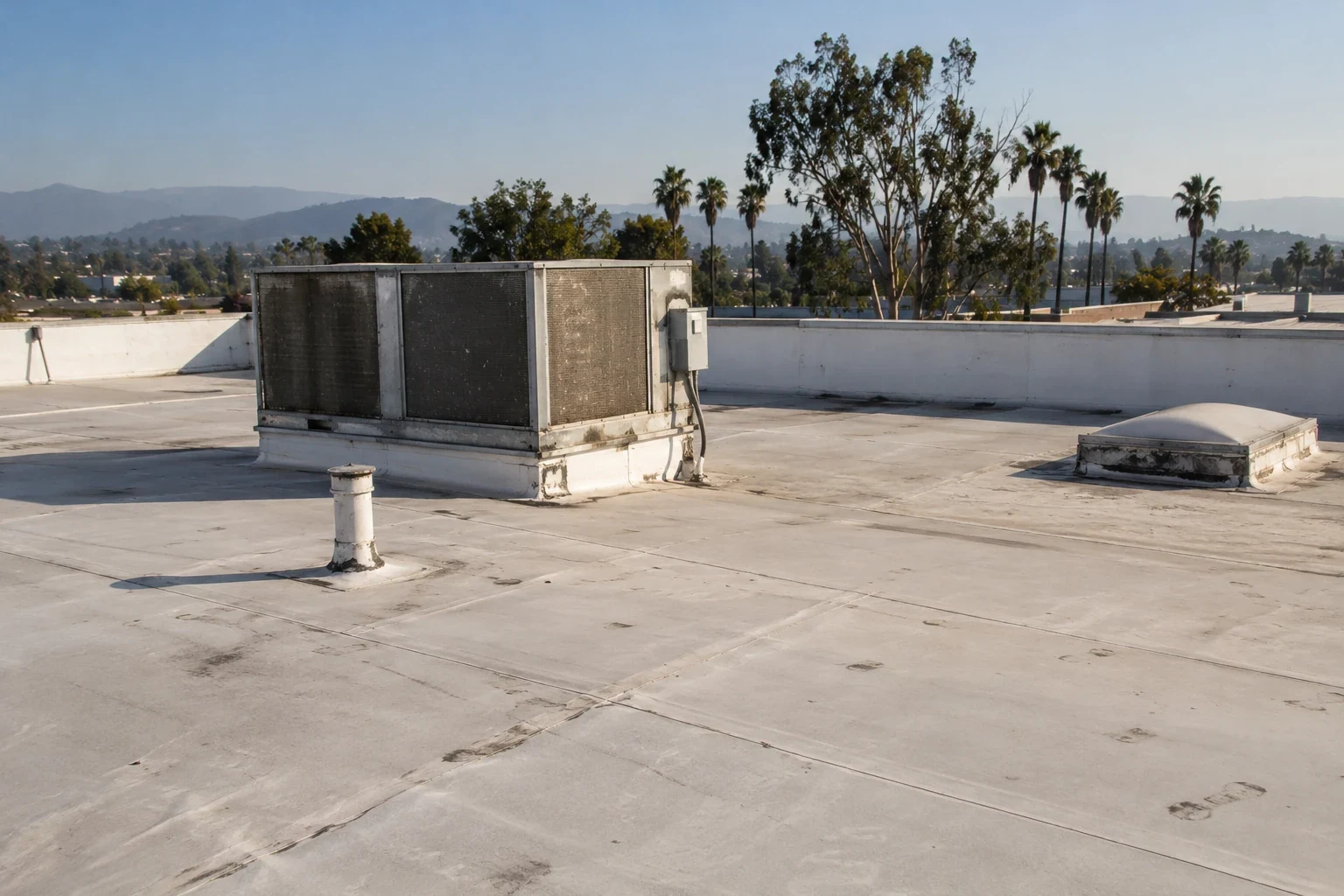

A PVC roofing substitution on a Fairfield, CA bid needs a construction review before the GC compares material costs. The membrane, supporting layers, attachment and details form an assembly, and a change in one component can alter preparation and procurement. We review the existing roof and project requirements, then describe the compatible work needed at seams, penetrations and edges. That gives the pricing decision a useful basis beyond the color or nominal thickness of the sheet.
The local heat record includes 117 F in Fairfield on September 5, 2022. Historical exposure makes material handling worth planning but does not establish a surface temperature or specification for a new roof. in Downtown Fairfield, the County Administrator's office provides an institutional identity reference for coordination around occupied uses. Each PVC project needs the actual property's construction and access established before the GC sets removal, staging and closure dates.
Review the full assembly
A PVC membrane needs components selected for the intended construction. We review insulation, cover board, attachment and accessory details together, including the requirements at retained materials. Compatibility cannot be assumed between unrelated repair compounds or another membrane type. The bid should identify preparation or separation needed at those interfaces, especially where older overlays have left materials that do not appear in the original drawings.
Our inspection before PVC procurement helps establish the existing condition and the limits of what can be confirmed without opening. The GC can resolve those limits through a defined investigation task instead of carrying an unexplained substitution allowance. At a property in downtown Fairfield, interior access and roof delivery arrangements can affect the inspection schedule. Confirming them early allows the assembly review to finish before the material decision becomes a construction deadline.
Price seam preparation
A welded PVC connection relies on suitable material and surface preparation as well as the welding operation. We examine old repairs, contamination and adjoining sheet condition before defining a tie-in. The selected method and system requirements govern what can remain and what needs removal. A short visible seam can involve more preparation than a longer clean production lap, making detail condition a cost driver rather than length alone.
Against a proposed TPO system, the PVC bid should be compared using complete compatible details and attachment. Similar joining terminology does not establish that accessories or methods can be exchanged. We explain the differences relevant to the assignment so the GC can review the scope without assuming one sheet simply replaces another. Submittals should resolve complex penetrations and perimeter connections early enough to account for specialized components or preparation before mobilization.
Investigate exposure near equipment
Exhaust, grease or other discharge near roof equipment can affect the surface and the detail selected for that area. We identify the actual exposure and review the proposed system requirements rather than label PVC universally suitable for every chemical environment. Equipment personnel may need to correct a discharge route before roofing preparation begins. That coordination belongs in the bid sequence because cleaning alone will not remove a continuing source of contamination.
For roof work associated with restaurant operations, the assigned property's exhaust and access conditions need confirmation. A KEE membrane alternative also needs project-specific compatibility review before selection. The GC should identify the substances and operating constraints that matter to the proposed assembly, then resolve the system with the relevant technical requirements. Material labels cannot replace that investigation or establish a blanket resistance claim for an unknown exposure.
Prepare the supporting layers
Wet insulation or damaged cover board can leave a new weather surface without a suitable base. We examine suspect areas and describe the investigation needed to establish removal limits. A recover requires a sound retained assembly and compatible connections, not merely enough room to add another sheet. Where the findings support selective reconstruction, the bid should identify the depth, attachment and tie-in work clearly.
Our replacement of unsound supporting layers can be coordinated with the PVC detail work. The GC should arrange deck and interior access where another trade or additional evaluation is required. Material delivery and a planned closure boundary come before removal, reducing avoidable exposure while the base is open. The roofing schedule includes surface readiness checks because dampness, temperature and preparation requirements can affect the actual connection even after replacement boards are available on site.
Coordinate completion and later access
A finished roof needs details that remain accessible without inviting damage during equipment service. We discuss traffic routes and practical protection at the assigned building, then record the installed construction and any retained condition outside the scope. The GC should provide that information to the operator and equipment trades so new work is not immediately punctured or contaminated by an unplanned service approach.
Our care of PVC seams and roof details can address changing conditions after installation, with the interval selected for the roof and use rather than a universal calendar. Emergency response can be arranged through nights, weekends and holidays, with timing confirmed for the property. Permanent closeout distinguishes completed membrane and flashing work from separate equipment corrections, allowing the owner to understand which exposure has been resolved and which responsibility still requires attention before the whole building task is complete.
Confirm the room requirements
NorthBay Health Medical Center is in Fairfield; the assigned room use determines the practical restrictions and equipment isolation needed before opening. The assigned room use determines practical restrictions and any equipment isolation needed before opening. We review those tasks with the GC early so the installation sequence includes the building requirements alongside PVC accessories and field material.
PVC seam acceptance depends on preparation as well as machine settings. Keep the trial weld on representative material, let it cool, and check separation at the sample before production begins. During installation, note changes in temperature, wind exposure or roll storage that call for another trial. Probe completed seams after they cool and repair skips before covering the transition. Around drains, curbs and changes in plane, document the accessory and weld approach separately so the inspection record identifies what was actually installed.
Commercial Roofing Questions
Is PVC suitable for every exhaust exposure?
Identify the actual discharge and review the proposed membrane requirements before selecting the system. Chemical compatibility varies with the material and exposure. We recommend coordinating equipment corrections as well, so a cleaned roof is not returned to the same continuing contamination immediately after installation.
Can existing TPO repairs become PVC tie-ins?
Review the connection rather than assume compatibility between membrane types. Retained compounds or patches may require removal or another detail approach. We inspect the adjoining material and explain the preparation needed for the selected PVC assembly before the GC prices the interface as an ordinary welded lap.
Should nominal sheet thickness settle a substitution?
Compare the full assembly and the project requirements, including accessories, attachment and supporting layers. Thickness alone does not establish equivalent construction. We can identify the labor and procurement changes associated with the proposal so the GC reviews the substitute against the complete scope.
Why can a small detail carry a larger labor allowance?
Contamination, removal and preparation can control the work more than the visible seam length. Older patches or complex geometry may need reconstruction before joining begins. We recommend describing that condition in the bid so the detail allowance reflects the actual task and can be compared fairly.
How should closeout address equipment problems?
State the roofing work completed and identify any separate discharge or support issue still assigned to another trade. The operator needs that distinction to coordinate the remaining correction. We recommend handing over access and protection information so subsequent service work does not damage the new membrane detail.
Related Roofing Work
Send the roof scope early
Send the Fairfield PVC specification, existing materials and equipment exposure information early. We will review compatibility and supporting work so the substitution, price and installation sequence can be assessed together.