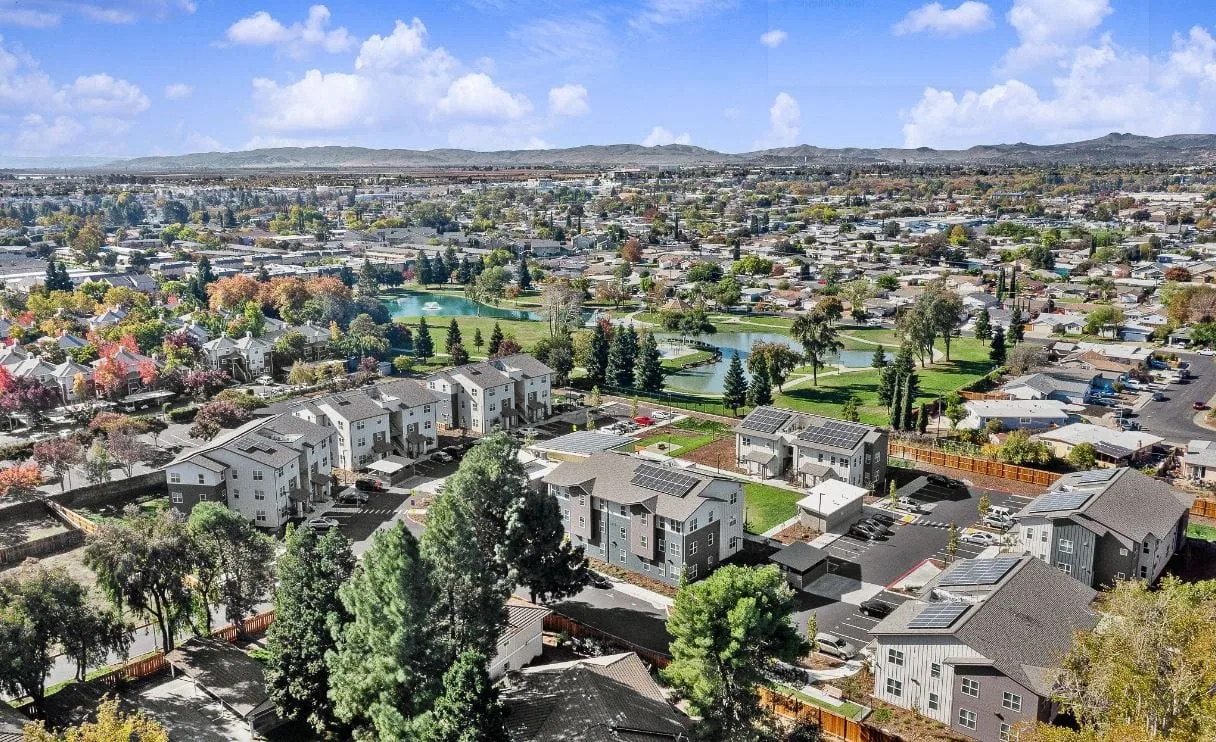

Fairfield Corporate Commons roof work begins with the cost question behind retaining the existing assembly. A GC may be comparing recover with removal while the field membrane appears useful but moisture beneath it remains uncertain. We inspect low-slope and metal construction, investigate suspect areas and define the work necessary for a suitable base. Repairs, restoration and replacement are considered against those findings, with access and equipment interfaces part of the same construction plan.
The Fairfield Corporate Commons location follows I-80 and Highway 12 in Fairfield, CA; Lincoln Highway, also called Suisun Valley Road, provides its access identity. That geography locates the park discussion without establishing the material or condition of any roof. Historical local heat includes Fairfield's September 5, 2022 reading of 117 F. It provides exposure context while the actual assembly, readiness and project requirements establish the roofing scope and the schedule used to carry it out.
Retained layers determine suitability
A recover requires useful construction beneath the new surface. We examine accessible layers, attachment and suspect moisture, then identify further checks where the roof prevents a complete assessment. The report states those limits rather than assume a sound field means every supporting layer is dry. The GC should resolve accessible uncertainty before the overlay becomes the base bid and carry a defined allowance only for the concealed condition that remains unsettled.
Our evaluation before a roof recover connects those findings to the proposed assembly and detail changes. Work in Green Valley Corporate Park needs an independent review of its assigned roof. Similar park geography does not establish the same retained layers or attachment. We explain which components can remain and what correction is necessary beneath the new surface, allowing the GC to compare a complete recover scope with removal rather than an isolated membrane quantity.
Detail heights affect reconstruction
Added layers can change curb, edge and outlet relationships. We measure those interfaces and identify reconstruction needed to connect the proposed roof to existing equipment and drainage. A retained penetration may need modification even where the field supports recover. The bid should include those tasks so a lower removal quantity does not conceal unresolved details that later control completion.
Our work at changed penetration interfaces can be coordinated with the equipment trade where lifting or support correction is necessary. A property near Cordelia Road may need a different approach based on its actual equipment and access. The GC should assign those responsibilities early and resolve the detail submittal with the field system. That keeps procurement linked to a complete connection instead of delivering roof material while an unsuitable curb remains waiting for another decision.
Selective removal needs measurement
A localized wet area can sometimes be rebuilt while useful layers remain nearby. We investigate its extent and define the connection between replacement components and retained construction. Survey patterns need interpretation and suitable confirmation before becoming removal limits. Where damage extends beyond the opening after work begins, we document the condition and explain the additional correction before the scope expands.
Our moisture investigation of proposed retained layers can support that decision where the method suits the assembly. For work over office accommodation, roof openings also need interior access and protection coordinated with the operator. A unit price for selective removal should state the construction it covers, including attachment and tie-in. The GC can then review additional quantities against an understandable basis rather than a general instruction that combines unlike roof repairs under one measure.
Occupied work needs a secure sequence
Retaining the field does not eliminate exposure at altered penetrations, edges or damaged areas. We plan those openings and secure closure with the building contact before removal, including any electrical or ceiling concerns handled by appropriate personnel below. Material staging and equipment isolation must be ready when the detail is opened. The schedule should not assume an overlay can proceed without operational coordination simply because the roof is not being removed everywhere.
Our written roof findings for option review identify the construction basis and unresolved conditions behind the proposal. The GC can use them to resolve submittals and procurement with the necessary detail work. Surface moisture and temperature influence application readiness, so the permanent sequence includes checks at the actual connection. We explain a hold where requirements are not met and keep temporary protection distinct from the final tie-in that completes the correction.
Comparable scopes address the defects
A useful roof comparison shows what each option corrects and what remains below it. We describe the condition supporting recover, repair or replacement and explain where a wider project is necessary because local work would leave unsound construction. Access, selective removal, attachment and detail reconstruction can change the cost difference. The GC should assess those tasks together rather than assume one system label establishes the least disruptive or least expensive approach.
Urgent roofing assistance is available overnight as well as during holiday and weekend periods, with response timing confirmed for the address and conditions. Temporary protection can support that review while investigation and procurement proceed. At handover, we identify the installed or repaired boundary and retained limits so later inspections can interpret the assembly correctly. Equipment trades receive relevant access information, reducing the chance that subsequent work damages a new connection or treats concealed retained construction as though it no longer affects repair.
Corporate Commons lies along I-80 and includes city-marketed office, biomedical and technical-support operations. A project request should still name the exact building and operator, since the park designation does not establish roof construction, tenant hours or access permission. We coordinate inspection, equipment staging and work periods with that property's contact, then report the assembly and conditions observed. Where a campus has several structures, keep findings and repair quantities assigned to each roof so a shared business address does not blur which building was examined.
Commercial Roofing Questions
Can a sound-looking field establish that recover is suitable?
Investigate the supporting layers and attachment before making that decision. Surface condition can conceal wet insulation or altered construction. We recommend defining the retained base and unresolved checks so the GC compares a complete recover proposal with removal rather than assuming the new surface resolves every hidden issue.
What detail changes belong in an overlay bid?
Measure curb, edge and outlet relationships against the proposed added layers. Reconstruction may be needed even where the field remains useful. We identify those tasks with the system submittal so the GC does not accept a recover quantity that leaves unsuitable interfaces outside the price.
How should selective reconstruction be priced?
Use a stated assembly, removal depth and tie-in basis for comparable areas. Survey findings require interpretation and confirmation where uncertain. We recommend documenting concealed differences before changed quantities proceed, allowing the GC to review additional work against a practical construction description.
Does retaining the roof remove occupied-building protection?
Local openings can still expose the interior. Confirm the work boundary, equipment coordination and temporary closure before details are removed. We recommend carrying those tasks into the schedule even when most of the field remains, because overlay construction does not eliminate every exposure.
What distinguishes a useful comparison of roof options?
Show the findings each option addresses and the construction it retains. Preparation, attachment and interface work can change both price and timing. We explain those drivers for the assigned building so the GC assesses equivalent problem resolution rather than a field material number alone.
Related Roofing Work
Send the roof scope early
Send the Fairfield Corporate Commons building information, recover proposal and detail drawings early. We will define retained-layer condition and interfaces so the roof options can be compared as complete construction.