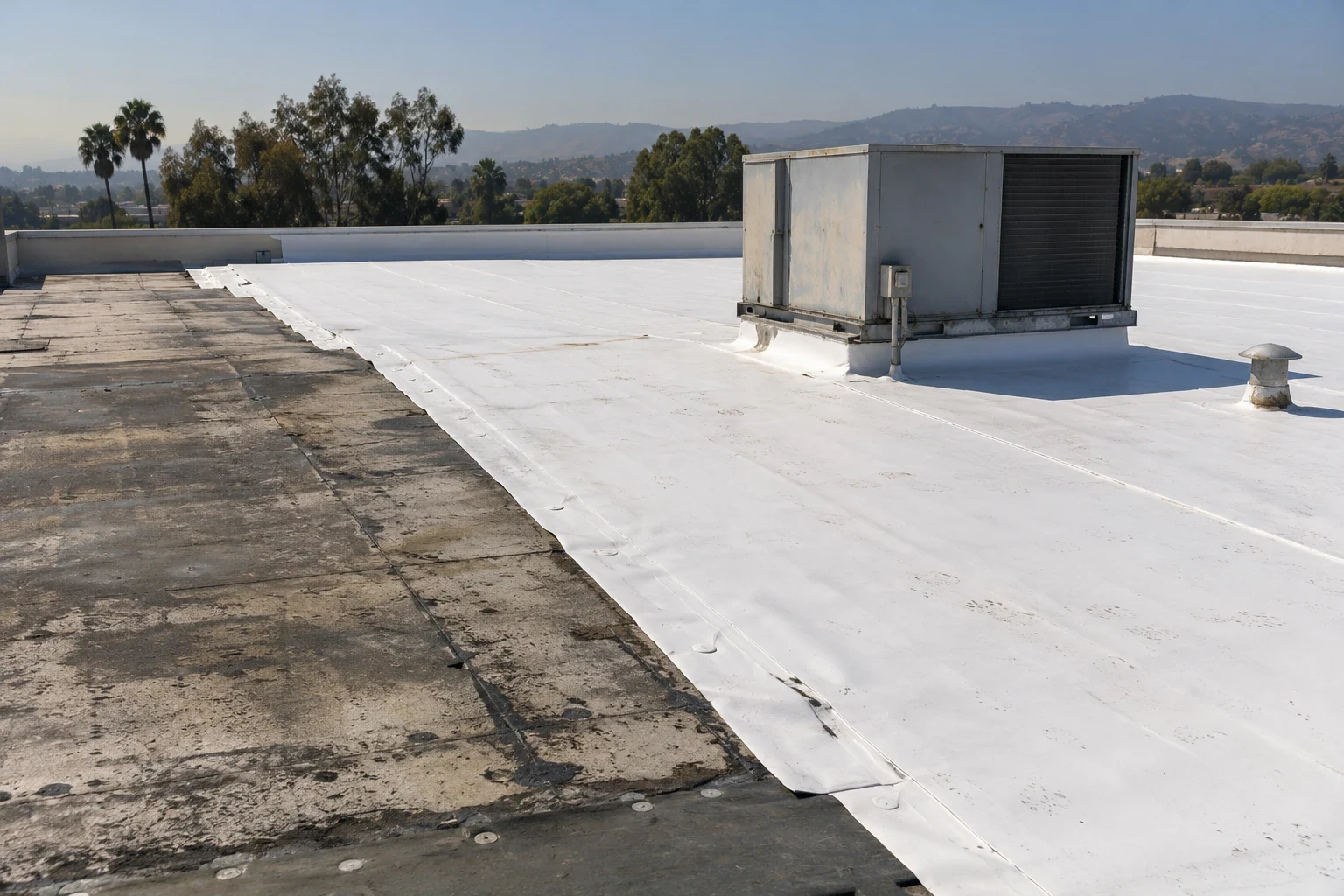

An overlay price needs an existing-assembly decision before the general contractor can rely on its omission of removal work. Roof recover and overlay in Fairfield, CA, starts with the layers proposed to remain, their moisture condition and the supporting construction available for the new assembly. We investigate those conditions and describe unresolved items before pricing a recover as the base scope. Carry the investigation ahead of procurement, so a budget option does not become an ordered assembly before its supporting roof has been assessed.
Access and interior use influence that investigation schedule. NorthBay Health Medical Center is a hospital in Fairfield where any roofing request would need its own assigned building and operator release. We determine which layers can remain by examining the assigned roof and reviewing its records. Send the actual property records and authorized work boundary with the recover request, so cores, access and protection can be planned for the structure in question rather than inferred from its use.
Retained layers need assessment
Existing coverings and concealed deterioration can change recover feasibility. We compare records with appropriate openings to identify the layers, their condition and the supporting material. Applicable project and code requirements also need review; a layer count by itself does not approve an overlay. Include that review in the preconstruction sequence and identify who resolves the design question. If a required condition remains unconfirmed, the bid should state it plainly instead of treating an intact-looking surface as proof that the assembly can stay.
Investigation locations affect how well the findings represent the roof. A core at a convenient corner may not describe a repaired zone or a different construction area. We discuss the selection and closure of openings before the visit, including interior protection where needed. Pair hands-on roof examination with the assembly records so the proposed retained layers have an evidence basis. The contractor can then distinguish a known recover condition from an allowance for additional investigation or local removal.
Suspected moisture needs confirmation
Moisture can remain beneath an apparently continuous membrane and make it unsuitable as the supporting assembly for new work. We identify suspected areas and the checks needed to confirm the condition. An infrared moisture investigation may guide that task under suitable survey conditions, but interpretation must account for construction and other influences on the readings. Schedule confirmation before the recover quantities are finalized. A scan should not become an automatic map of exact wet-material removal without a suitable assembly check.
Local wet-material removal adds disposal, replacement layers and a transition into the retained roof. We define that work separately rather than assuming a small surface patch resolves moisture below. The scope should identify how the removal quantity is measured and how changed boundaries are approved. Send any leak history and earlier repair drawings before the survey so unusual zones can be considered. That helps the bid separate known restoration work from a recover option whose supporting condition remains uncertain across part of the field.
Added thickness changes details
Added roof thickness changes the relationship between the finished surface and curbs, drains, doors and wall flashings. A connection that looked adequate before the overlay may need reconstruction at the raised elevation. We assess accessible details and identify the height information still needed. Include connection quantities and design requirements in the bid package, because the field area alone does not account for that work. The recover comparison should show which details remain and which must change to suit the proposed assembly.
Material compatibility adds preparation that cannot be assumed from the new membrane name. A PVC recover assembly needs the specified separation and supporting layers, while a new EPDM system has its own joining and attachment requirements. We price the selected construction with those interfaces resolved. If an alternate changes the supporting board or fastening approach, submit it for the project’s review before using its field-material price to estimate the entire overlay scope.
Attachment needs supporting construction
Attachment work depends on the structural deck and the layers between it and the new roof. Fastener selection or testing may need further investigation when the supporting construction is uncertain. We identify that requirement before treating the overlay as a simple sheet installation. Have the design team address structural capacity and the complete proposed assembly where required. Retaining existing layers changes the construction question, and a light field membrane does not remove the need to assess the actual load and attachment path.
Equipment releases can also control when details are rebuilt. For changes at equipment curbs and supports, identify the trade responsible for lifting or disconnecting equipment and the period when the connection is available. We discuss temporary closure and permanent tie-in requirements around that task. Put the release beside the recover phase on the schedule, so membrane installation does not advance past a curb whose supporting or flashing work is still blocked by another trade.
Preparation and application differ
Application conditions can affect the recover sequence even though wholesale removal is omitted. Fairfield’s September 5, 2022 heat record was 117 F, a historical city observation rather than a measured roof condition for the project. We assess actual surface and ambient conditions against the selected material’s requirements. Allow the day plan to distinguish cleaning, board placement and permanent adhesion where appropriate. A procurement date may release materials to the site while the application still needs a suitable supporting surface and working conditions.
Controlled access can add repeated setup on an occupied property. For work in the NorthBay medical district, the assigned manager must release the actual building and overhead zone before investigation or construction proceeds. We explain the proposed material route and protection limits. Carry those assumptions into the recover bid and the full-removal comparison, so the two options are assessed against similar access requirements instead of one receiving an undefined allowance for occupied-space work.
An overlay proposal serving Vacaville, needs a building-specific review of retained layers, attachment and added height at edges and equipment.
Commercial Roofing Questions
Should we request a recover price before the cores are complete?
A preliminary option can identify assumptions, but the retained assembly must be assessed before the scope is committed. Include the investigation and closure work in the preconstruction plan. We update the quantities and detail requirements from findings rather than treating a preliminary field price as an approved overlay.
How should local wet removal appear in the overlay bid?
Show the defined replacement layers and a measurement method separately from the retained area. Include removal, disposal and the transition back into the supporting roof. We explain where moisture is confirmed and where further checks remain so the allowance does not stand in for an unexamined assembly.
Can raised flashing be omitted if the field membrane is thin?
Check the complete added thickness and finished detail, including supporting board and insulation where specified. The membrane alone does not establish the new elevation. We identify connections needing review before the design team resolves which can remain and which require rebuilding.
What must a recover alternate say about structure?
Identify the complete proposed assembly and the retained layers for the design review. Loading and attachment depend on the actual deck and framing condition. We flag missing construction information so the contractor can resolve it before procurement rather than rely on a broad claim that a membrane adds little weight.
Does omission of tear-off remove all occupancy restrictions?
Detail work and localized removal can still expose occupied areas. Compare those tasks with the operator’s release requirements and protection plan. We describe the proposed boundaries and equipment coordination so the recover schedule reflects the work that remains even when the broad field stays covered.
Related Roofing Work
Send the retained-layer information
Send the roof records, proposed overlay section, leak history and access limits. We will identify the investigation and connection work needed to compare recover with removal.