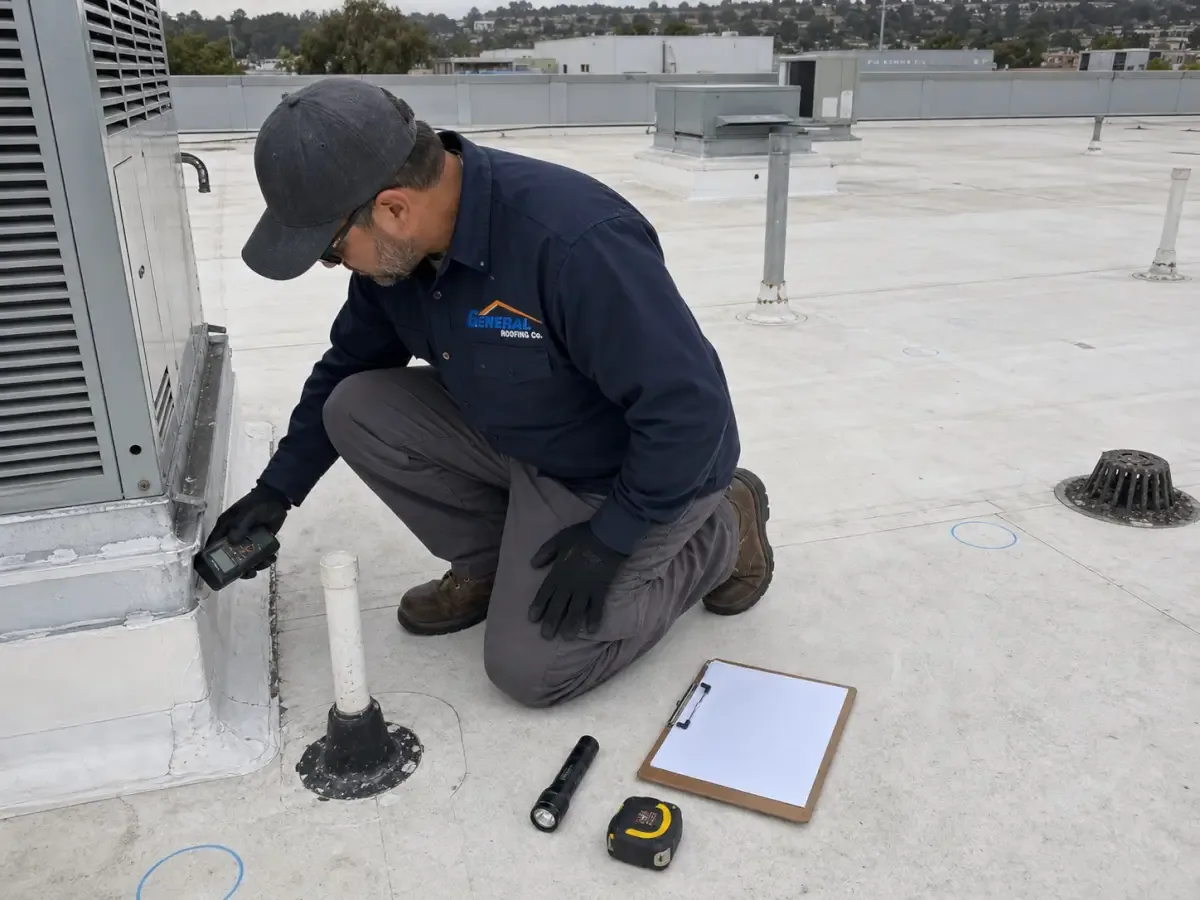

An inspection date can appear on a project schedule before anyone has defined what the resulting report must settle. We prepare commercial roof condition reports in Fairfield, CA, to give a general contractor findings that can support the next scope decision. The visit should establish the affected locations, accessible construction and examinations needed to distinguish a repairable detail from a wider assembly concern. Its deliverable needs to explain what can be priced and what remains unresolved.
For a proposed project near NorthBay Health Medical Center in Fairfield, a healthcare project would require the facility's actual instructions for access and occupied-space protection. Those instructions must be obtained from the responsible operator. We identify how such requirements affect the proposed examination and any authorized opening, so the general contractor can coordinate the visit before assigning a construction task from its findings.
The question defines the examination
A request to investigate a leaking curb calls for a different examination than a request to assess an entire replacement area. We establish the decision being made and the roof boundaries it concerns before the visit. The building contact should identify the interior symptoms and any known changes near the affected space. Their account helps direct the examination without establishing a cause from the timing of a complaint.
With a hands-on inspection of the relevant construction, we compare the reported concern with accessible roof details. We record the examined area and any limitation that affects the conclusion. The general contractor then receives a scope-related finding instead of assuming that a visit to one leaking connection establishes the condition of every roof level.
Findings need marked locations
A defect photograph needs a location that another trade or estimator can identify on the building. We relate the observed condition to a marked drawing or an unmistakable roof reference. The record includes the component involved and enough adjoining construction to explain the proposed correction. This helps distinguish a wall termination from a field seam even when both are above the same occupied room.
The dated record of roof areas and completed repairs can supply earlier locations for comparison. We examine whether those locations still describe the construction present, retaining earlier work as history rather than a current condition finding. A later equipment change or new penetration should have its own record. That prevents an old repair description from becoming the quantity or method for unrelated new work.
Concealed conditions need suitable evidence
A surface examination can describe an open connection without proving the condition of insulation below it. We identify when that uncertainty affects the repair boundary or the choice between retained construction and removal. Further examination may involve authorized openings, appropriate moisture testing or a screening method used to select investigation areas. The scope should include how the opening will be closed and who authorizes work over the occupied space.
Infrared screening with suitable confirmation needs its conditions and limits retained alongside the findings. A temperature difference does not establish moisture by itself. We explain the additional evidence needed before a removal quantity relies on the result. The general contractor can then distinguish a survey task from a confirmed construction quantity and schedule the decision that depends on it.
A priced correction needs construction details
A recommendation to seal a flashing needs a defined component and usable receiving material. We examine the vertical detail, termination and adjoining field roof, then describe the preparation and connection appropriate to the identified system. A surface finish may not address a loose termination or unsound backing. The report should explain those distinctions so the proposed task includes the construction needed to correct the observed defect.
Repair of the affected flashing connection also needs a boundary tied to sound material. We identify where surrounding deterioration or concealed condition could change that boundary. Where the evidence supports a local correction, the report should not imply a whole-roof failure. Where broader examination is required, it should state the question that must be resolved before a larger scope is proposed.
Visit conditions affect the coverage
Fairfield recorded 117 F on September 5, 2022. For a present examination, we assess actual access and roof conditions rather than use that historical reading as a measurement of the subject assembly. Heat can affect safe work and the handling of materials needed to close an authorized opening. Those considerations may change the visit sequence, and the report should retain any resulting coverage limit.
For a project in the NorthBay medical district, the specific facility's operating instructions also affect the visit. We confirm the route to the examined area and the protection needed below any proposed opening. A condition report should identify an inaccessible area plainly, along with the access or examination required later, instead of treating an incomplete view as a complete assessment.
The findings define the next estimating task
A report becomes useful for estimating when each recommendation identifies the affected location, proposed intervention and remaining uncertainty. We distinguish immediate protection, a permanent correction and further investigation. An active leak may require a holding measure while the retained construction is assessed. The written findings should preserve that separation so temporary work is not carried into the bid as proof that the permanent repair boundary is settled.
A later capital decision about the roof may need wider examination than the immediate correction. We identify that requirement and retain the evidence supporting it. The general contractor can use the report to coordinate authorization, investigation and pricing in the correct order. After work, the completed location and any approved change should return to the construction record, making the next examination easier to interpret.
A dependable condition report identifies the inspection date, weather, accessible roof areas, method of examination and limits on observation. Pair each finding with a location marker and photograph that a facilities manager can use in a later work order. Separate visible defects from concealed conditions and state which access or testing would resolve an open question. Recommendations should connect each repair option to the observed assembly, urgency and likely trade dependency, without presenting a reserve estimate as a bid for work that has not been designed or measured.
A report for a building near Cordelia Junction should name the inspected structure and access limits, not generalize from the interchange.
Commercial Roofing Questions
What should the inspection request say before the visit is scheduled?
State the roof area, the reported problem and the decision the owner needs to make. We recommend including available drawings and the relevant access instructions. Those items help us define the examination and its deliverable, so the general contractor can schedule a visit that answers the intended pricing question.
Can a limited visual visit establish a recover scope?
Confirm which retained-construction questions the visit can actually answer. We describe any concealed layers, attachment or moisture condition that remains unresolved. Where those findings affect recover suitability, further authorized examination belongs before a firm scope is proposed rather than inside an unsupported assumption.
Why should the report keep access limits with its findings?
A limitation affects how far the conclusion can be used. We identify the area not examined and the information needed to assess it later. The estimator can then separate a confirmed repair task from a roof area that still requires access or investigation, avoiding quantities based on an incomplete view.
How should temporary leak protection appear in the report?
Record its location and purpose separately from the permanent recommendation. We explain the defect discovered and any condition still being examined beneath or beside it. This keeps the immediate holding measure useful without treating it as evidence that the larger assembly decision has already been resolved.
Which report details help turn a recommendation into a bid?
Use a marked location, the observed condition and the proposed preparation and connection. We retain the unresolved boundaries and outside-trade responsibilities with those details. The general contractor can then identify the work to be priced and the owner decision needed before that quantity or method becomes firm.
Related Roofing Work
Send the inspection question before assigning the visit
Share the affected roof drawing, reported concern and available access instructions. We will establish the examination needed to support the next roofing scope and pricing decision.